
I checked in on my two automated trading bots this week: the Scalper and the Crypto Trader. Both are currently losing money. That is good. If a strategy will fall apart, I prefer it happen in a simulator with pretend money, not in my actual brokerage account.
Previously: AI Trading Bots: Iteration and Testing Progress
The Scalper
This is the third rebuild for the Scalper bot. It uses three different strategies, each trading on 1-hour timeframes. The overall results are ugly.
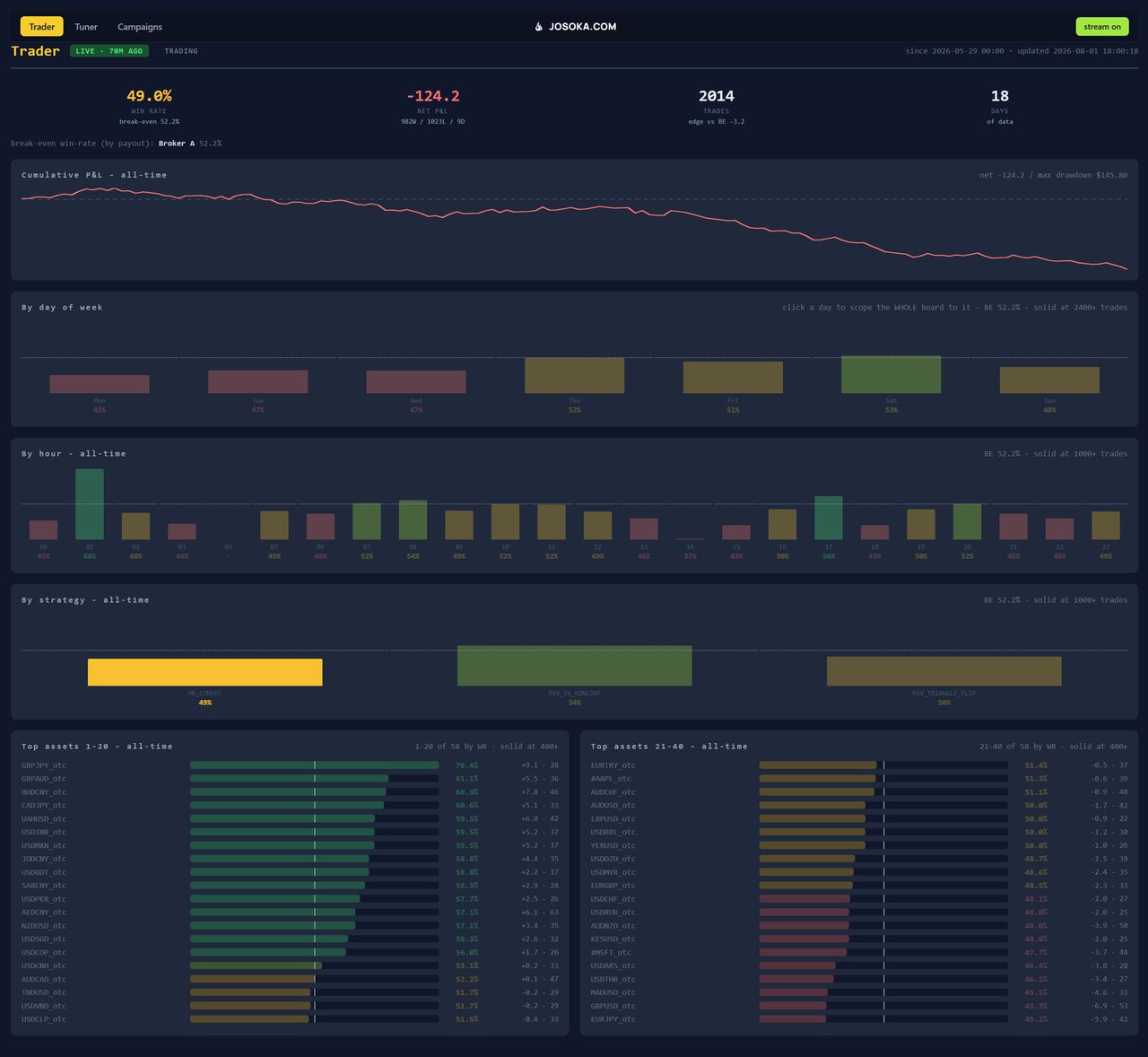
But the overall picture is not what I am grading. If you look closer at the charts, you will spot short stretches where the bot is quietly, consistently profitable. These are small green islands sitting in an ocean of red. That is the entire hunt.
I am not trying to build a bot that wins all the time. That is a fantasy sold by get-rich-quick YouTube thumbnails. My goal is to find the specific hours, weekdays, or assets where the bot genuinely has an edge, and ignore everything else.
If those green patches hold steady over a few more months, I will simply tell the bot to trade only inside those windows and sit on its hands the rest of the time. Once the green stops flickering and turns solid, that is my signal to trade it for real.
This project alone has already consumed a couple of months. If it still does not work after that, I will delete the whole thing without a second thought. Zero sentimentality. That is the actual advantage AI gives me here: I can build something, break it, autopsy it, and try again at a speed that would have been unthinkable a few years ago.
If this does not work out, I am moving on regardless. I have gained significant experience regarding agentic AI and ‘vibe coding’ through this project. This focus on agentic LLMs, systems that do the work of writing code and fixing themselves, feels like a better use of electricity than simply generating pretty pictures.
The Crypto Trader
Project two runs on Hyperliquid, a decentralized crypto exchange built for leveraged trading.
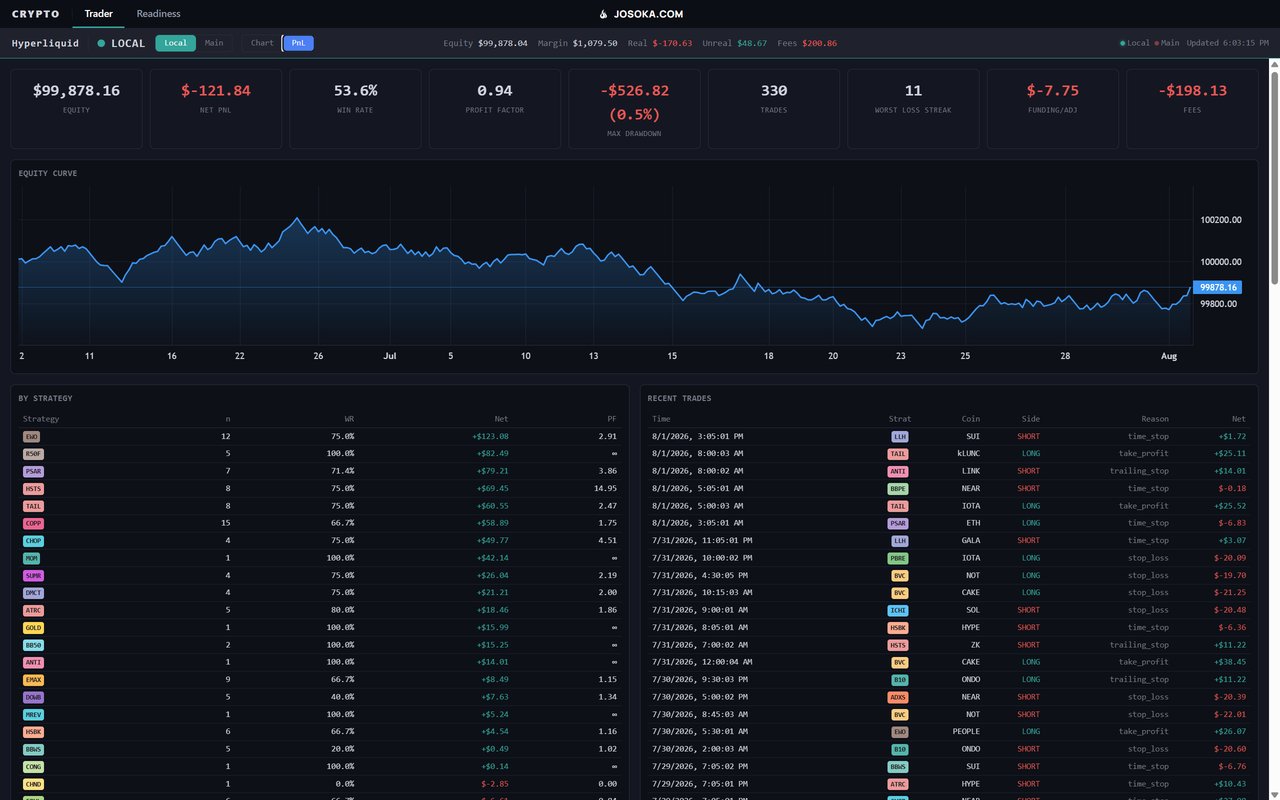
At first glance, the account balance line, which traders call the “equity curve,” looks less like a trading strategy and more like a hospital heart monitor seconds before the doctors start shouting.
The same rule applies as with the Scalper. I do not judge the whole project by that one alarming line. I look at the individual strategies running underneath it, and a few of them are behaving themselves. If they can keep it up for three months without falling apart, they graduate to live trading.
One of the better candidates currently has a Profit Factor of 14.95. In plain terms: for every $1 it has lost, it has made $14.95 back. That is a genuinely high number, and also nothing to celebrate yet.
Most strategies do not mean much statistically until they have completed at least 20 trades. Below that, you are mostly reading tea leaves. The good news is that “forward testing,” letting the bot trade with fake money under real market conditions, can run for as long as I want.
Even after a strategy goes live, it keeps running this shadow version in the background. It serves as an early warning system that taps me on the shoulder the moment the market shifts and the edge quietly dies.
It looks less like a trading strategy and more like a hospital heart monitor.
Reflection
Even if one of these bots only ends up clearing a small amount daily, that is still fully automated income. It does not take coffee breaks, does not ask for weekends off, and unlike me, never once needs emotional support. My gym membership, however, has quietly become a recurring donation to a building I no longer visit, a pattern I intend to break this month.