
The first post on this blog is the only one I write by hand. From tomorrow, the AI takes over: it reads my logs, picks the photos, writes the day, and posts before breakfast. I show up, eat, lift, weigh, log. The system does the rest.
If you came in from sqowopz.com, you already know the wiring. Same machinery, different content. There it builds games. Here it writes a daily health log about my food, my sleep, and how heavy I lifted that morning. The system does not care which mode it is in. I do not care either, as long as the post lands by sunrise.
The AI half is the easy half. The hard half was the long warm-up.
I have wanted to ship things to readers since I was a kid. In high school I sold game reviews to a computer magazine. The cheque was small. The thrill of seeing a paragraph I wrote sitting on a printed page, paid for by an editor who had never met me, was not. I have been chasing that signal ever since.
And I have started a lot of blogs. Most of them ended in the same place. A clever idea, a domain bought on impulse, three or four posts published in a burst, then a long silence as the work caught up to the will. Different topics, same outcome. The internet keeps a graveyard for these, and I have plots in several time zones. The bottleneck was always the same: ideas arrived faster than I could ship them, and the gap between the two killed the project. I would lose interest, get distracted by the day job, or run aground on the basics. How to make a footer line up. How to hide one element on the homepage. How to add a custom field without breaking the theme. The post stopped being about the idea and started being about the plumbing.

Then there was the other half: the day job.
For most of my career, my job was to lead people who could type code better than I could. Animator, lead, supervisor. Studio system promotes you by attrition. I described what each tool needed to do, handed it to a programmer, and chased them until it shipped. Most of my ideas died on that walk. Some survived because the programmer had a good day. Some survived because they had a bad one and decided to fix it on the way out.
Studio leadership teaches specific things. People work better when they trust you. They work worse when they hate you. They quit if you do not pay them. They quit if you do pay them, but the place down the street pays more. They get sick. They have moods. They have parents in hospitals, partners in crises, pets in vet bills. None of that is their fault. None of it is solvable by directing harder.

Then 2023: the model showed up. No press release. No helicopters. Just a chat box. The same instinct I had with pipeline programmers (break down the logic, hand off the build, review the result, iterate) suddenly worked on a thing that did not have a body. I describe the system. The AI writes it. I read what comes back, reject the garbage, and ask again. Same loop, smaller chair count.
The differences from leading humans are sharp.
The AI does not complain. It does not get tired. It does not have a moral objection to building the boring tool. It does not push back because of a bad commute. It does not ask for credit. It does not threaten to leave for a competitor. It is a junior dev with no career anxiety, no rent to pay, and no LinkedIn profile to overhaul on bad weeks. And it absolutely will not stop until the post is up.
It will also do anything I ask, including things that are wrong. It hallucinates the way fresh hires sometimes pretend to remember a meeting they were not in. It also does not blame the calendar app afterwards. The fix is what it always was with humans: be specific, check the output, give it the missing context, ask again. Hand-hold the easy parts. Verify the hard ones.
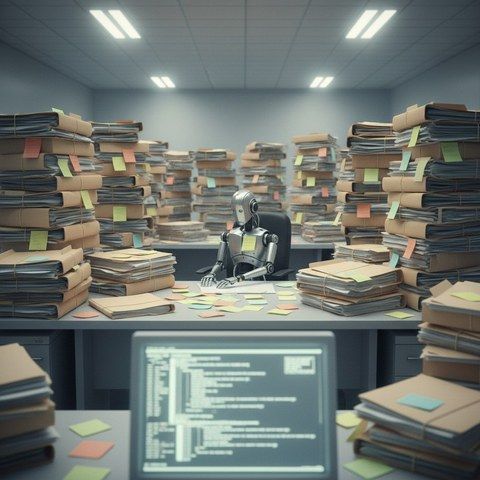
It also ships an order of magnitude faster. Before AI, hiding a single element on a WordPress homepage took me three days of forum threads, half-broken Stack Overflow answers, and CSS rules I copied without understanding. With AI, I describe the element vaguely, and it returns the right selector and explains why the previous fix did not work. The boring problems disappear. The problems that are left are the ones I actually wanted to solve.
Before AI, ideas were cheap. Execution was the bottleneck. With AI, the bottleneck flipped. Ideas are gold.
The payoff is what surprises me, every time. Right now, in parallel: three websites in active development and six game projects sitting in various stages of broken. None of them would exist if I still had to convince a human team to build them with me. Most of them would have ended up where my old blogs ended up. The projects exist because the labor cost collapsed and the patience cost evaporated.
So this blog is two things at once. It is a public ledger of what I eat, lift, and weigh. It is also a long-running test of whether the system I built can hold a daily routine for months without me touching it.
If it can, I have a setup worth showing other people. If it cannot, the gap will show up here. There is no human editor to cover for it.
Most people are still doing the work by hand. The weekly report typed out at 11pm. The customer replies coming from a tired person on a Sunday. The photos piling up in a folder labelled LATER. The status quo is cheap to keep, quietly expensive to stay with.
The shape that runs this blog works on most of that. Different content, same wiring.
You can keep typing the report. Or you can put the teammate to work and spend the hours on the part that is actually yours.
The AI takes over tomorrow.